Tab Marshal

Tournament tabulation for collegiate mock trial

Tab room Team portal

For tab rooms and tournament directors

Pairings, judges, ballots and standings, run to the letter of the rules.

Tab Marshal runs the tab room of a collegiate mock trial tournament from the first draw to the final placement. It pairs each round as the tabulation rules require, keeps judges clear of conflicts, catches ballot errors as they are typed and records every step, so any result can be explained to any coach who asks.

Request a demoOpen the tab room

The Round 4 overview: the stages from paired to closed, a list of what stands between the round and closing (three ballots missing, one with an error, three not yet verified), and each trial with its room, teams, judges and ballots. The Round 4 overview: the stages from paired to closed, a list of what stands between the round and closing (three ballots missing, one with an error, three not yet verified), and each trial with its room, teams, judges and ballots.
Round 4 with ballots coming in. Three are still out and one has a score over 10, so the round cannot close until both are dealt with.
379tournaments replayed

Past results the standings engine is tested against.

8,650team records matched

Ballots, combined strength and opponents’ strength, team by team.

28scores on each ballot

Each one checked the moment it is typed.

2people on each ballot

One enters it; another re-adds it from the paper.

Pairing

Pairings by the book

Round 1 is a random draw that never sets two teams from one school against each other. Rounds 2 and 4 are side-constrained and Round 3 is a snake with sides open, each ranked on ballots, combined strength and point differential.

When a pairing would repeat a matchup or set two teams from one school against each other, Tab Marshal makes the smallest swap the rules allow and writes it on the pairer’s list. Review the proposal, swap teams by hand if you must, and save.
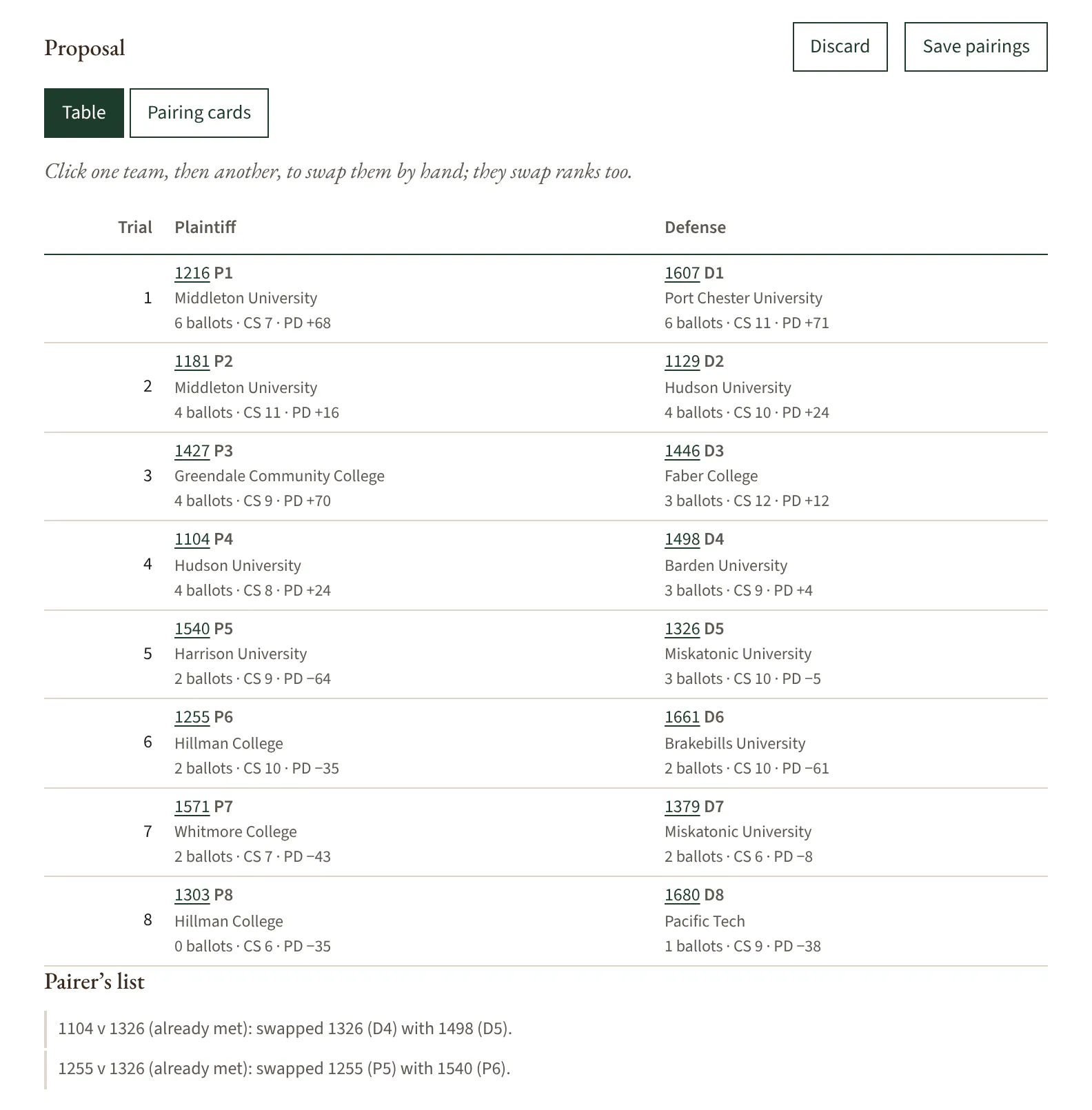
A Round 4 pairing proposal: eight trials, each team with its rank, ballots, combined strength and point differential, and a pairer’s list of two swaps made to avoid rematches. A Round 4 pairing proposal: eight trials, each team with its rank, ballots, combined strength and point differential, and a pairer’s list of two swaps made to avoid rematches.
Round 4 proposed from the standings after Round 3. Two rematches were avoided, and each swap is on the pairer’s list.

Judges and rooms

Every seat filled without a conflict

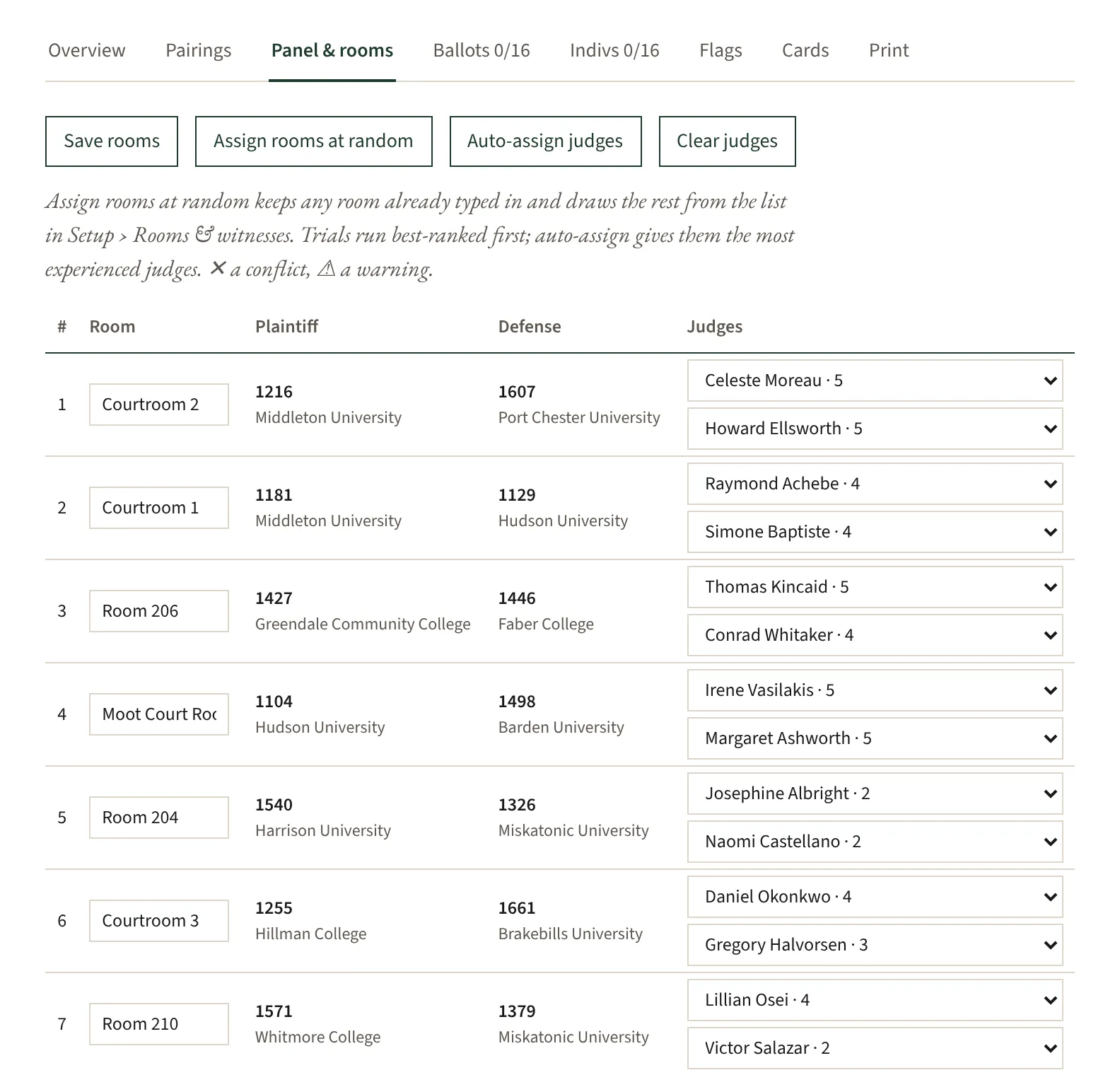
Auto-assign gives the best-ranked trials the most experienced judges. A judge’s declared conflicts keep them out of that school’s trials, and a judge who has already heard a team is flagged before hearing it again.

When a round closes, each judge picks up a conflict with the teams they scored. Courtrooms are dealt at random from your list.

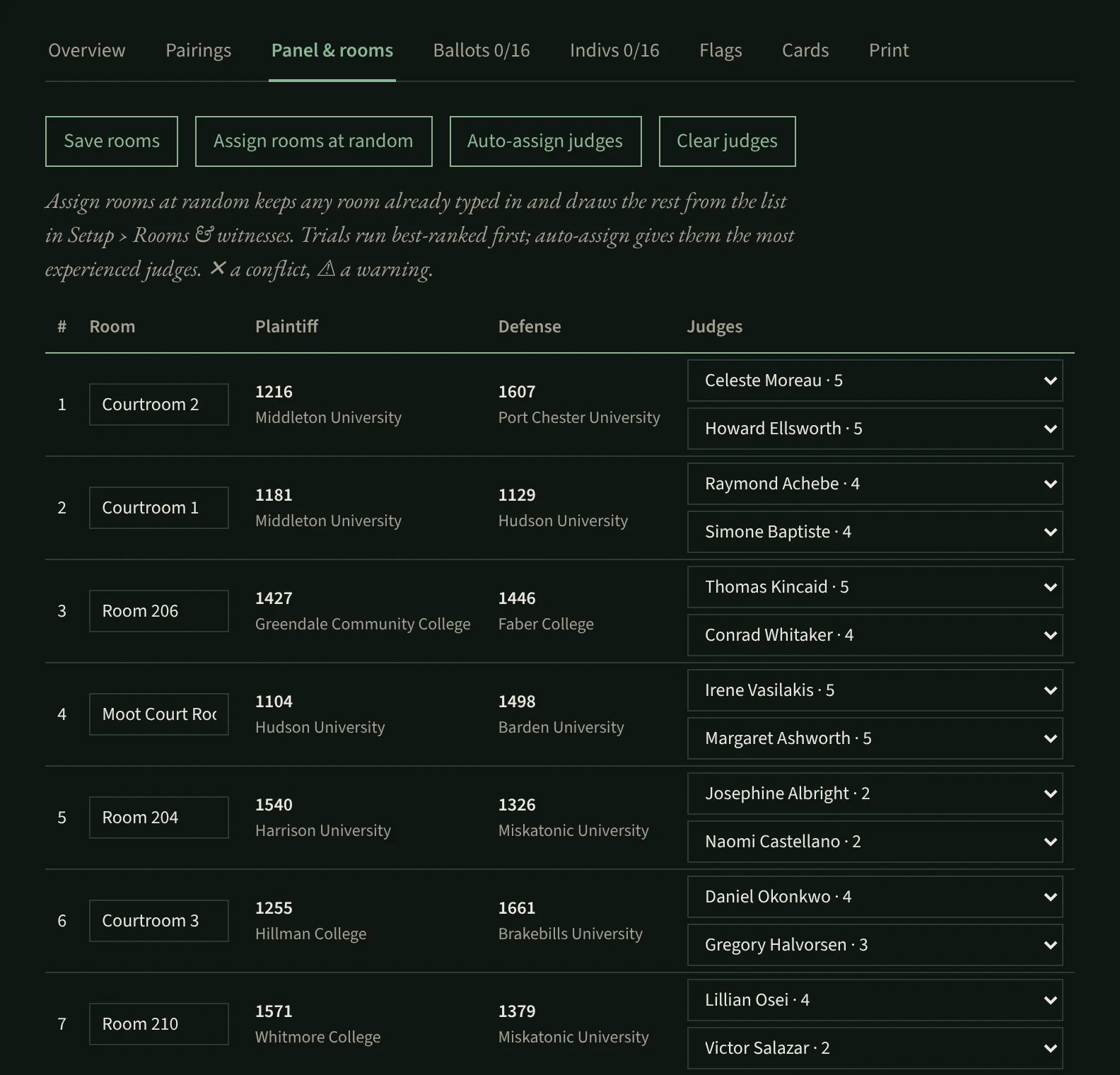
The Panel and rooms tab: each trial with its courtroom and two judges, each judge shown with their experience. The Panel and rooms tab: each trial with its courtroom and two judges, each judge shown with their experience.
Round 4 staffed by auto-assign: sixteen seats in eight rooms, none of them over a conflict.

Ballots

Every ballot checked twice

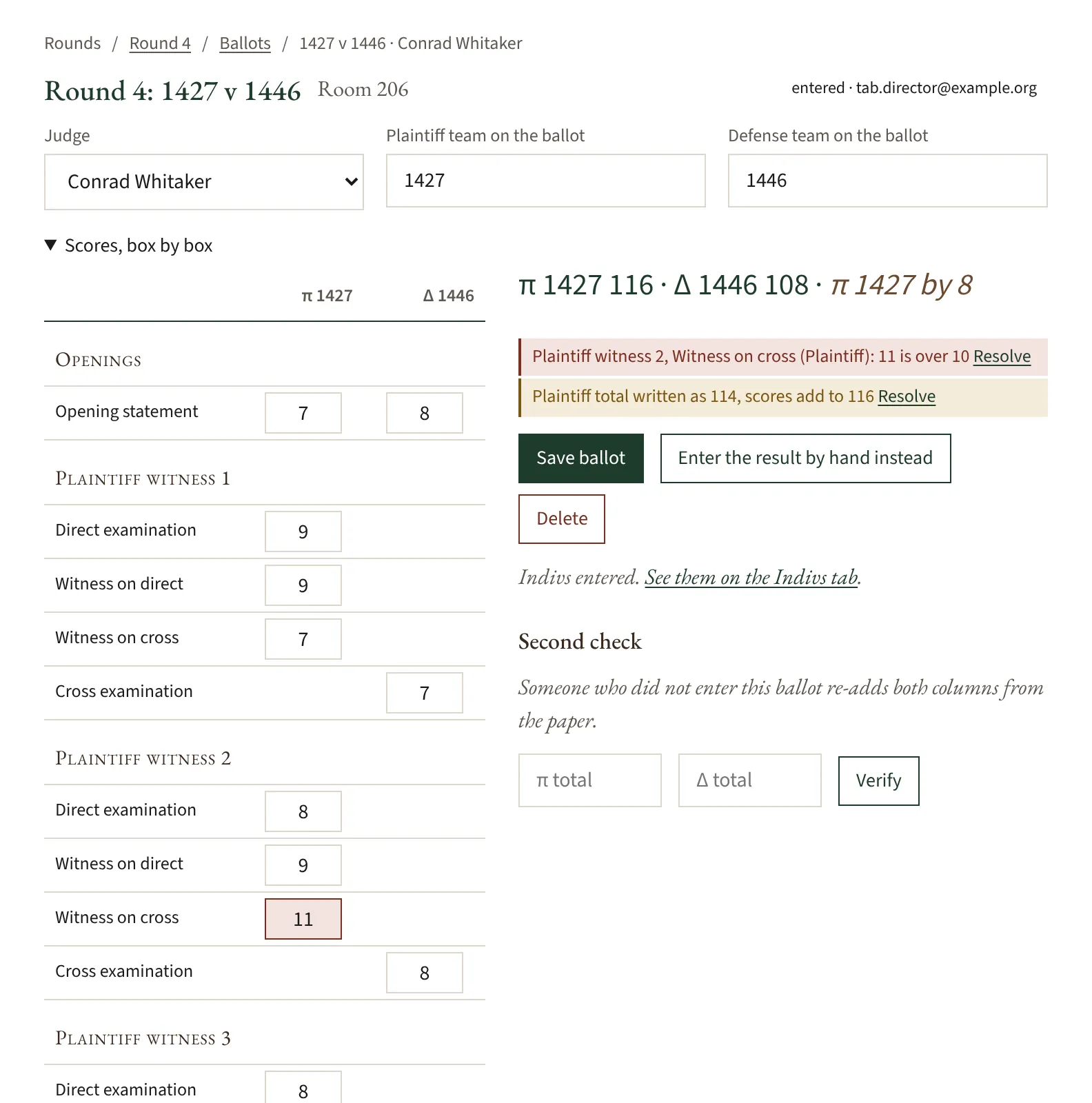
Enter a ballot as its result, as its two totals or box by box. The totals and the winner update as you type, and anything out of order is flagged on the spot: a score over 10, a zero, a blank line, a total that does not add up, teams that do not match the pairing.

Someone other than the person who entered a ballot re-adds it from the paper before it is marked verified. Ballots can also be photographed and read automatically; nothing read from a photo counts until a person has checked it against the paper.

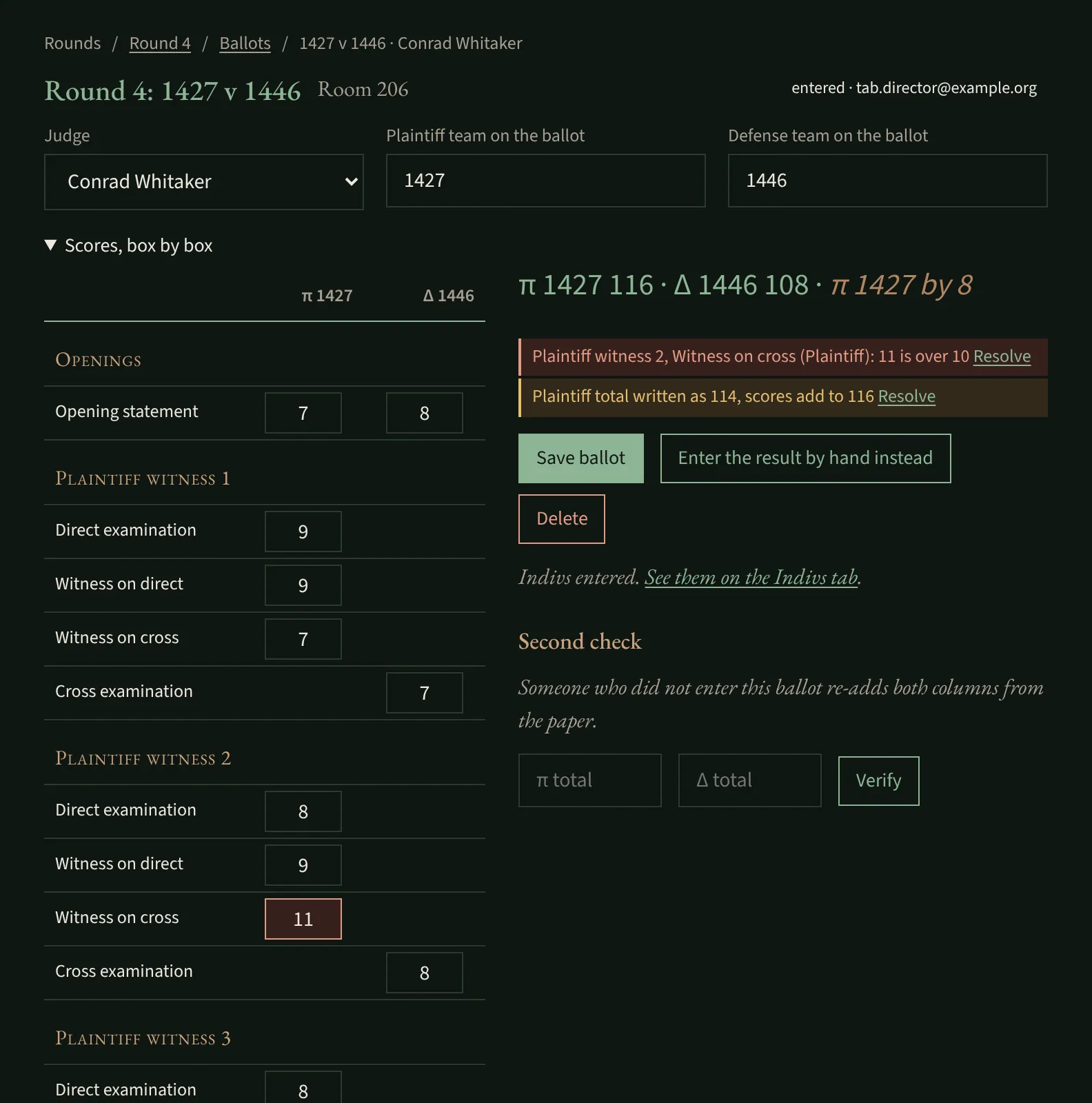
A ballot entered box by box. An 11 on a witness’s cross-examination is outlined, an error explains it is over 10, a warning notes the written total no longer adds up, and a second-check form waits below. A ballot entered box by box. An 11 on a witness’s cross-examination is outlined, an error explains it is over 10, a warning notes the written total no longer adds up, and a second-check form waits below.
An 11 typed for a witness on cross. The error holds the round open; the judge’s written total, which no longer adds up, is flagged beside it.

Results

Standings you can defend

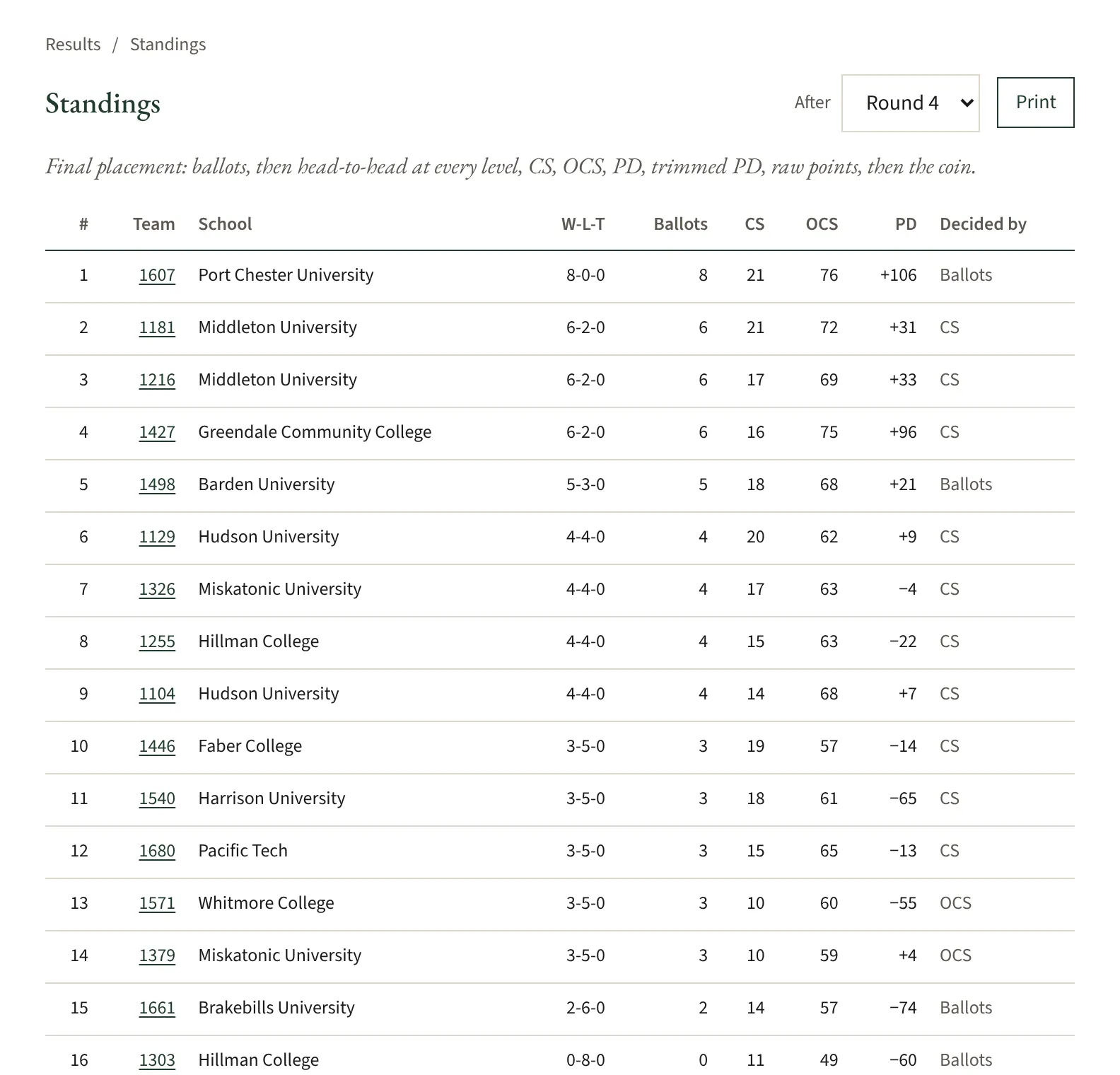
Final placement follows the full tiebreak order: ballots, head-to-head, combined strength, opponents’ combined strength, point differential, trimmed differential, raw points and the coin. Each row names the step that settled the team’s place, so no coach has to take a number on faith.

Individual awards are tallied from the ranks on every ballot, with tied ranks sharing their points.

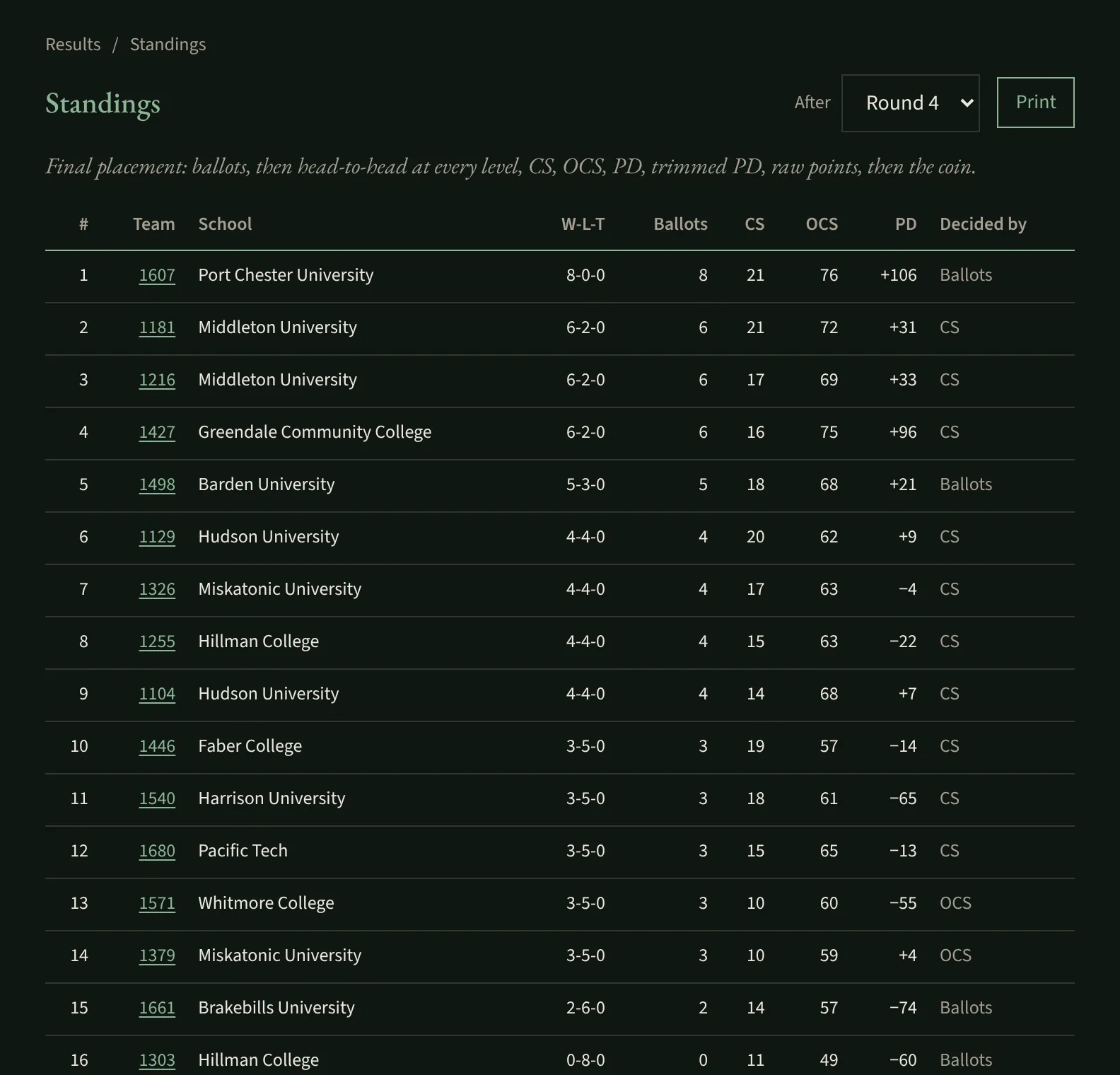
Final standings for sixteen teams with record, ballots, combined strength, opponents’ combined strength, point differential, and the tiebreak that decided each place. Final standings for sixteen teams with record, ballots, combined strength, opponents’ combined strength, point differential, and the tiebreak that decided each place.
Final placement after four rounds. The last column names the tiebreak that decided each place.

Teams and the gallery

Pairings on every screen

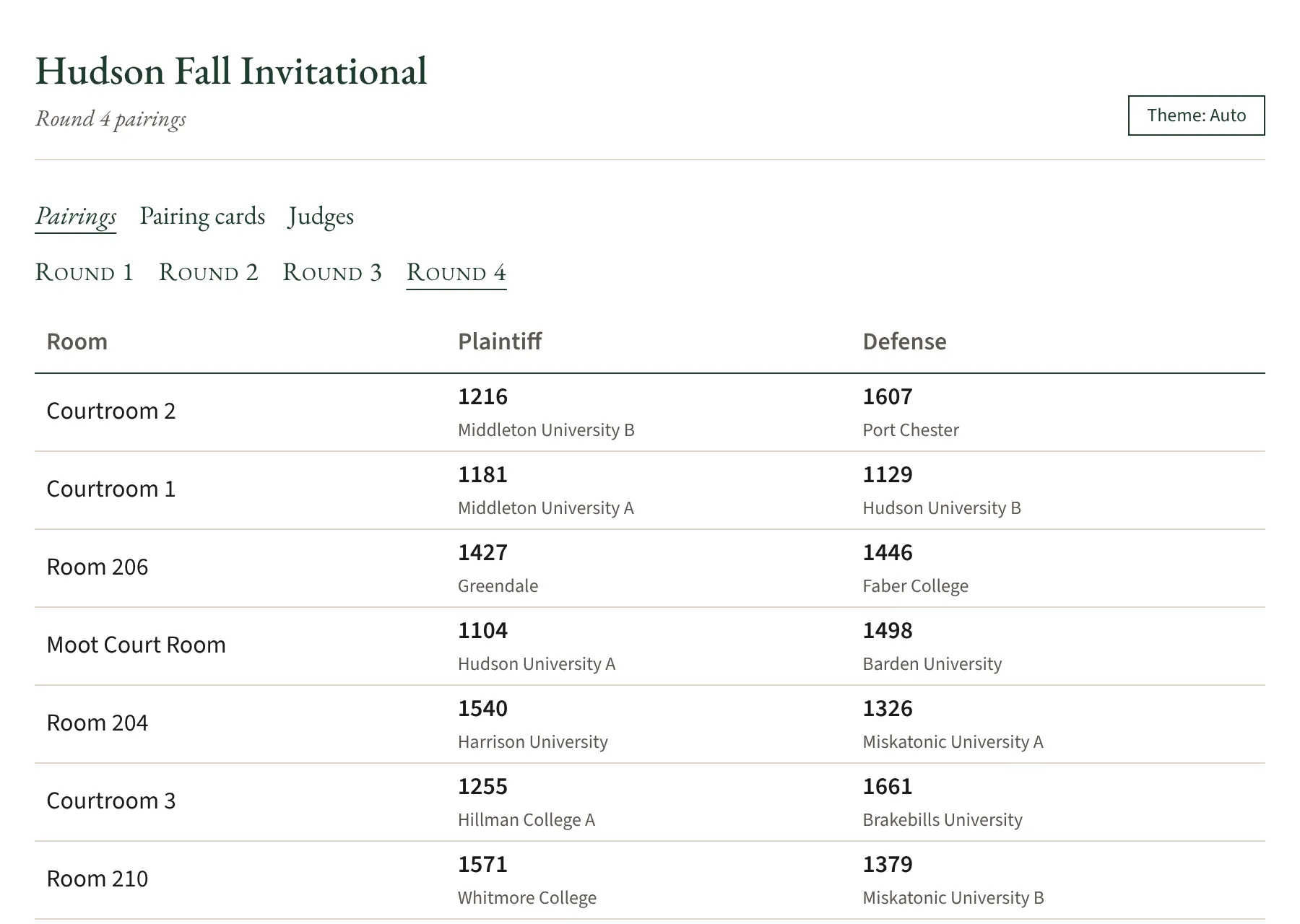
Published pairings, rooms and judges go to a public page sized for the projector in the assembly room and the phone in a competitor’s pocket.

Captains sign in to the team portal with their team number and a private code to see their pairings, send their witness lineup and sportsmanship ratings, and read their own ballots once results are released. The tab room itself works on a phone as well as at the tab table.

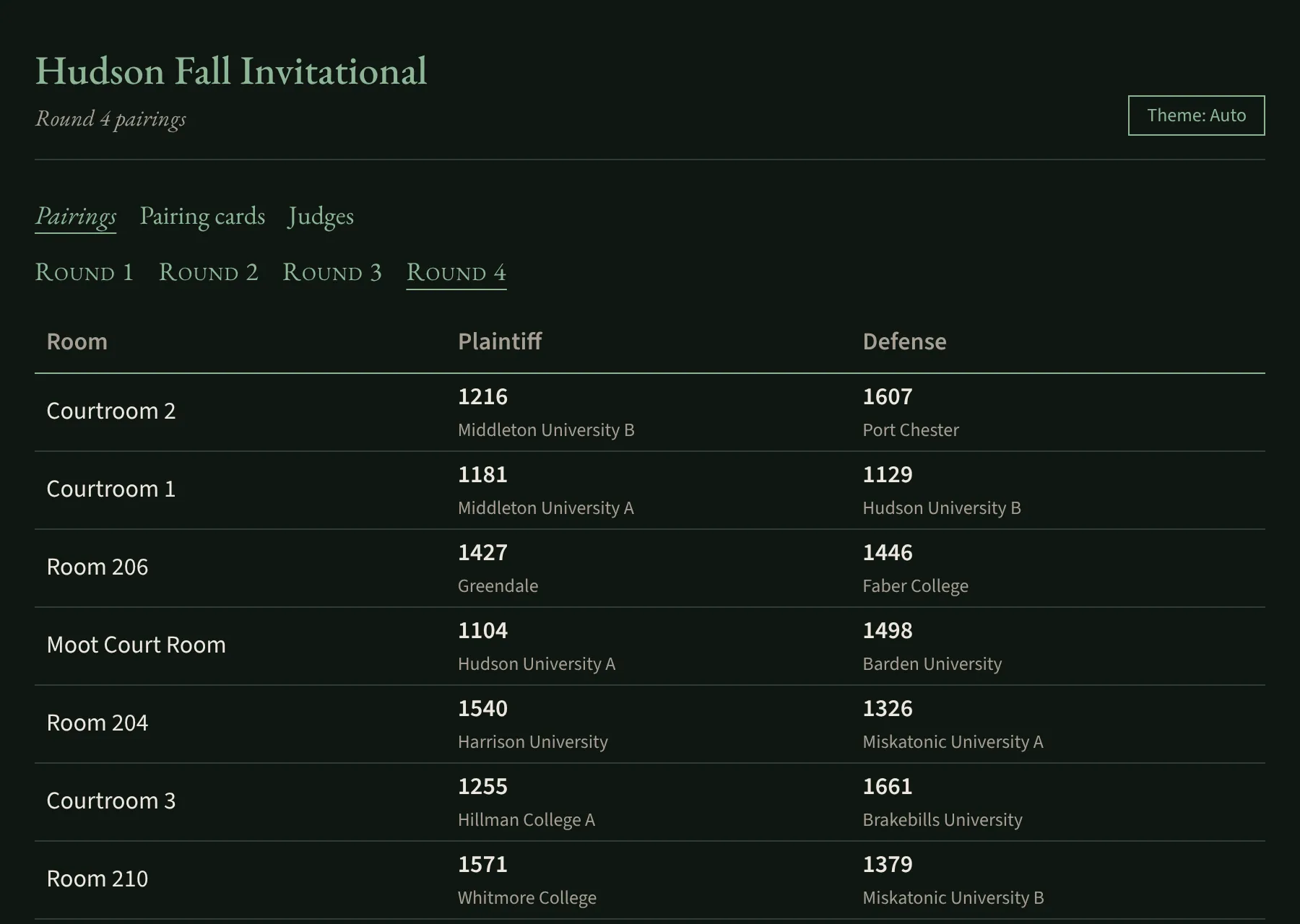
The public pairings page for Round 4: each courtroom with its plaintiff and defense teams. The public pairings page for Round 4: each courtroom with its plaintiff and defense teams.
The pairings page, as projected.
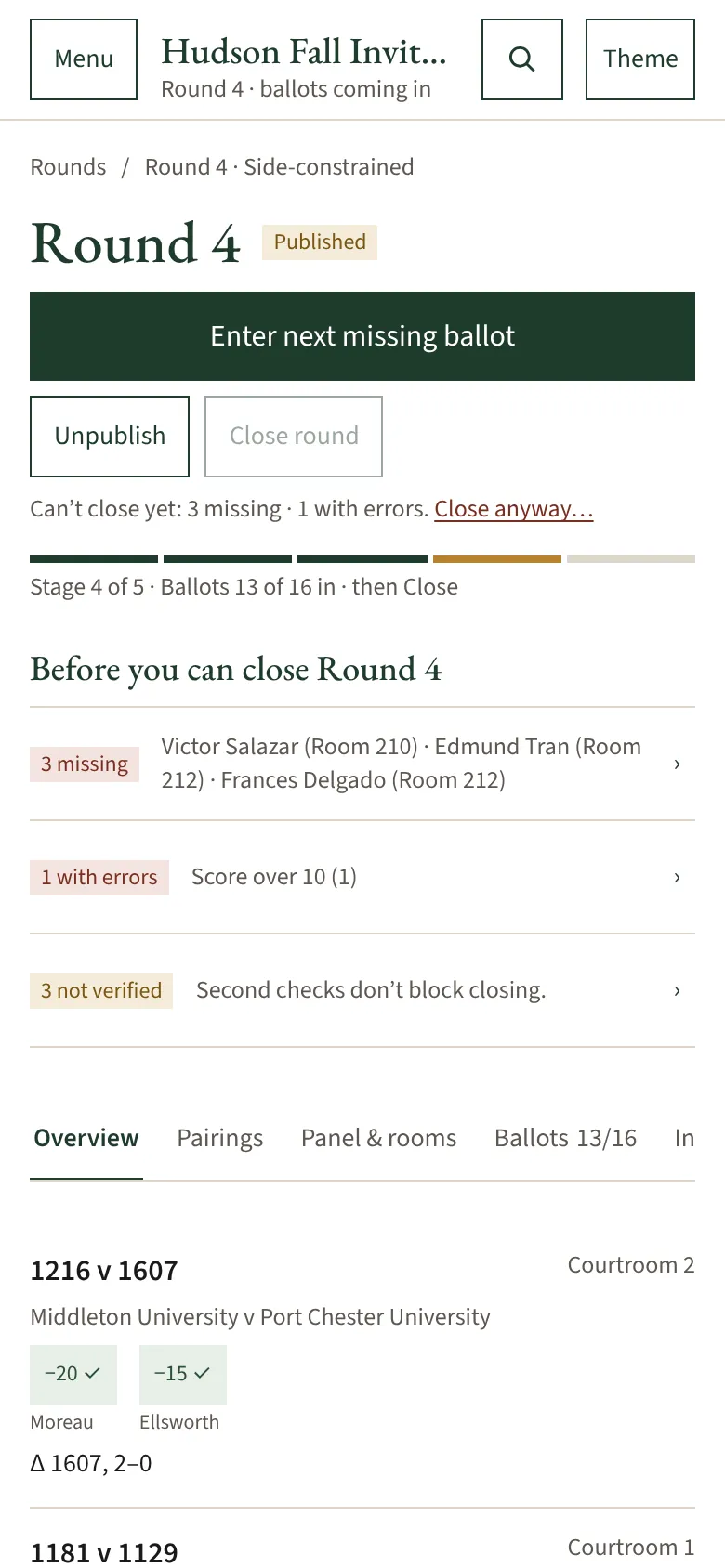
The Round 4 overview on a phone: the next step, the stage bar and what stands before closing. The Round 4 overview on a phone: the next step, the stage bar and what stands before closing.
The tab room on a phone.

Reliability

Built to be trusted

Tested against history

The standings engine is replayed against 379 past tournaments and has to agree with an independent recount of every team’s ballots, combined strength and opponents’ combined strength.

A record of every change

Pairings, judge seats, ballots, second checks and resolved flags are each logged with who made the change and when, for the questions that come after the awards.

Nothing closes early

A round will not close while a ballot is missing or an error is unresolved. Closing over them takes a deliberate override, and the override is logged.

Overrides on the record

A swap made by hand goes on the pairer’s list, and a judge seated despite a warning carries the written reason.

Locked to your staff

Only the staff you name can open the tab room. Team codes are stored only as hashes, and ten wrong guesses lock a team out for fifteen minutes.

Nothing to install

Tab Marshal runs in any current browser on a laptop, tablet or phone, in light or dark, with the pairings screen ready for a projector.

Want a demo?

Reach out to info@tabmarshal.app.

Sign in

Tab room

For tournament staff: teams and judges, pairings, ballots, standings and awards.

Open the tab room

Team portal

For captains, with the team number and code from the tab room.

Open the team portal

Pairings screen

Public pairings, rooms and judges. The tab room gives each tournament its own link.